Lake Lenexa Improves Water Quality
Lake Lenexa is located in Black Hoof Park within the Mill Creek Watershed in Johnson County Kansas. The lake and surrounding wetlands were constructed as part of Lenexa’s Rain to Recreation program which creates recreational opportunities while reducing flooding.
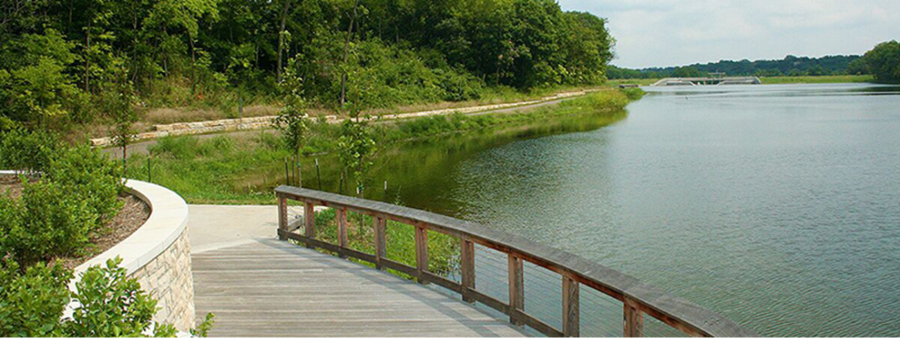 Lake Lenexa and its wetlands protect the Mill Creek Watershed from pollutants, keeping local streams healthier.
Water quality monitoring by the Johnson County Extension Master Naturalists suggests that stormwater abatement projects that utilize wetlands can combine recreational opportunities and flood control while protecting water quality.
Lake Lenexa and its wetlands improve stream health. Water passage through the lake and wetlands protects the watershed against toxic pulses of deicing salts and removes dissolved substances and suspended particles.
Learn more about...
Wetlands are best known as essential habitat for fish and wildlife and for their ability to control flooding. However, wetlands also benefit humans by filtering pollutants before polluted water reaches streams, rivers, lakes, and oceans. The ability of wetlands to remove plant nutrients is a unique ecosystem service provided by microbes that helps prevent excess growth that may lead to harmful algal blooms (i.e., eutrophication).
Three wetlands were built at Lake Lenexa, one wetland along the lakeshore and two upstream. While it is reasonable to assume that these wetlands also improve stream health, water quality monitoring had not been conducted since construction was completed in 2007. The Extension Master Naturalist Water Quality team is filling that gap.
Johnson County Extension Master Naturalists (EMNs) study Lake Lenexa and its wetlands to assess the effectiveness of the lake/wetland complex in improving regional water quality. Plant nutrients, turbidity, pH, total dissolved solids (TDS), and chloride are monitored upstream (the stream flowing into the lake and wetland) and downstream (the outflowing stream) of the lake, and at two sites within the wetland along the lakeshore. See initial findings from Lake Lenexa on the City of Lenexa’s website.
Chloride from deicing salts applied to highways is monitored because salt may pulse into streams and reach toxic concentrations harming aquatic life. EMNs regularly monitor chloride concentrations in the Mill Creek Watershed. Learn more about salt in Johnson County streams and wetlands.
For the most recent results and data please contact John Fleeger at zoflee@lsu.edu.
Lake Lenexa and its wetlands improve stream health.
Water passage through the lake and its wetlands protects the watershed against toxic pulses of deicing salts and removes dissolved substances as well as suspended particles.
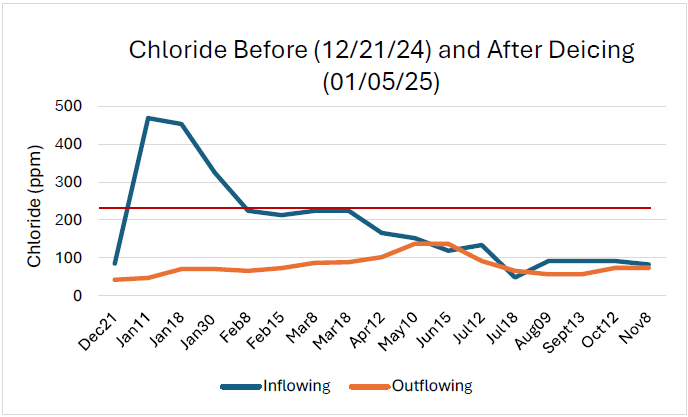
- Salt protection: In January 2025 after highway deicing, chloride spiked to ~450 ppm upstream—well above the EPA limit of 230 ppm for a four-day exposure—and remained at or above this standard throughout March, imperiling stream health. Downstream, however, levels slowly increased and peaked at ~150 ppm in June (see chart). The lake and wetlands alleviated the toxic pulse of salt, protecting downstream flora and fauna. It is even possible that the fish and invertebrates in the outflowing stream that are protected from chloride toxicity repopulate (by migration or reproduction) areas that experience acute chloride toxicity. The observed reduction in salt concentration in the lake’s outflowing stream is the first of its kind in the region and suggests that other impoundments and wetlands may provide the same service.
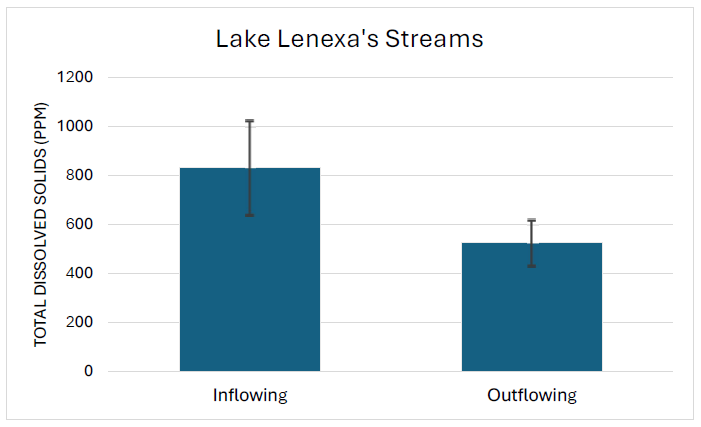
- Lower dissolved solids: TDS concentrations are lower, by about 40%, in the outflowing stream compared to water entering the lake and wetland (chart). Dissolved solids are composed of minerals, nutrients, and organic compounds that carry a charge and pass through a very small filter. TDS are general indicators of stream health and human activities because high TDS concentrations disrupt the osmotic balance of aquatic organisms causing stress and even mortality. Lakes and wetlands both remove TDS because suspended particles and organic matter trap some ions and then settle to the bottom and because plants absorb some dissolved solids. The large downstream reduction in TDS concentration will reduce stress for aquatic life within the watershed leading to improved water quality.
- Clearer water: The outflowing stream is less murky than the inflow after large rain events. Suspended solids (small, undissolved particles like silt, clay, algae, bacteria and organic debris that float in water) cause water to be murky and are present in streams mostly due to erosion. Solids block sunlight, making it difficult for plants and algae at the base of the aquatic food web to grow. Suspended solids also degrade the appearance of water and may negatively affect recreational activities. Flora and fauna downstream of the lake are healthier because of the reduction in turbidity.
- Nutrients under control: Nitrate, nitrite and phosphate concentrations are consistently low, at or below water quality standards, suggesting wetlands and community practices (like reduced fertilizer use) are helping prevent pollution. EMNs will continue to monitor nutrients in the lake and wetlands to determine if ongoing development around the lake affects water quality, serving as an early warning for lake eutrophication.
Related Resources
Black Hoof Park
City of Lenexa's Rain to Recreation Program