Swallowtail Butterflies
When I’m working in the landscape on a hot summer day, one of my favorite sights is a large, brightly colored butterfly drifting through the garden. By late summer, butterflies are often at their seasonal peak, making this a great time to enjoy their beauty and learn more about them. Among the many shapes, sizes and colors found in our gardens, swallowtail butterflies are some of the most striking.
Swallowtail butterflies are a subfamily of Papilionidae. While the family includes more than 500 species, there are fewer than 30 in North America. Swallowtail butterflies are easily recognized by the extended appendage on their hind wings, resembling the tail feathers of a swallow bird. Many species have bright colors on their wings, such as yellow, blue, and red. The striping and patterns on both the upper and lower surfaces of their wings make them especially showy when they flutter through your garden.
You can’t mention swallowtail butterflies without mentioning the poster child of this subfamily, the eastern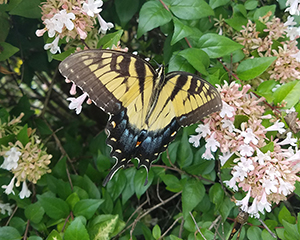 tiger swallowtail (Papilio glaucus). This large, striking butterfly is usually yellow with three to four distinct black stripes running parallel to its body. Some females, however, are completely black, mimicking the toxic pipevine swallowtail. Eastern tiger swallowtail caterpillars feed on a wide range of host plants, which helps make this species common throughout the states east of the Rocky Mountains. Host plants include trees such as eastern cottonwood, sweetbay magnolia, wild cherry and tulip poplar, as well as more landscape-friendly options such as spicebush, sassafras and wafer ash. Gardeners can also provide host plants in smaller spaces by growing herbs such as parsley, dill and fennel, which can serve as caterpillar food while adding useful plants to the garden.
Pipevine swallowtails (Battus philenor), as mentioned above, are butterflies that are toxic and distasteful to predators. They obtain this toxicity from the toxins in the Dutchman's pipevine (Aristolochia sp.) that the caterpillars eat. Pipevine swallowtails are pipevine specialists, meaning that they need pipevine to complete their lifecycle. These caterpillars aggressively feed in groups, just like the milkweed tussock moth I mentioned in a previous article. However, the aggressive growth of Dutchman’s pipevine allows for large-scale feeding without killing the plant.
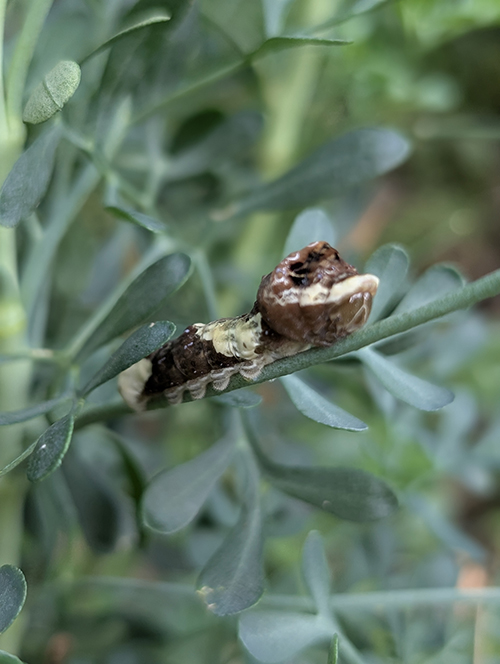 Giant swallowtail butterflies (Papilio cresphontes) are real showstoppers. They are large, with wingspans slightly exceeding 6 inches. This makes them the largest butterfly species in North America. They have black and bright yellow markings on the upper surface of their wings, while the underside has more of that same brightly colored yellow with interesting patterns of beige, blue, and orange. Caterpillars of this butterfly closely resemble bird droppings to hide from predators. Host plants for this butterfly are in the Rutaceae (citrus) family. Local native plants that support this species include prickly ash and wafer ash.
My personal favorite is the zebra swallowtail butterfly (Eurytides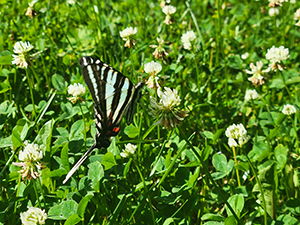 marcellus). Zebra swallowtails have black-and-white stripes running down their wings, with a red spot just behind the abdomen. The “tail” of this butterfly is particularly long, adding to the delicate way they float through the air. This black-and-white beauty is truly one of the rarer butterflies. Why? Because it has one host plant. Pawpaw trees, and due to human activity, are not as widespread as they used to be. People love these butterflies so much that pawpaws have exploded in popularity in recent years, often being the first tree to sell out at a native plant sale.
Swallowtail butterflies are always a fun surprise in the garden. Plant one of their host plants or provide season-long nectar, and you may soon see them fluttering by.
by Markis Hill, Horticulture Ornamentals and Turf Agent, 2026