Mill Creek Watershed
The Mill Creek Watershed is a central watershed completely contained within Johnson County, and encompassing a variety of land uses including agriculture, park and recreation, residential, and commercial/ industrial. View Johnson County land use in AIMS.

Continuing development and existing uses throughout the watershed contribute to runoff and discharges containing suspended solids and pollutants such as fertilizer, pesticides, and road salt. Mill Creek was listed as impaired for biology (suitability for aquatic life), suspended sediment, e. coli, phosphorus, and diazinon on the Kansas Department of Health and Environment’s 2024 list of Impaired Waters. View lists of Impaired Waters in Kansas from the Kansas Department of Health and Environment.
Sources of contaminants include surface water runoff from construction sites (suspended sediment), residential yards (fertilizers and pesticides), roads (oil and salt), and industrial sources such as wastewater treatment facility plant discharges throughout the watershed.
Johnson County Extension Master Naturalists have been monitoring Mill Creek since 2022 and using the collected data to educate the public in ways to reduce water quality Impacts. Master Naturalists have monitored three times a year since 2022 at the Johnson County Parks and Recreation District, Mill Creek Streamway Northgate Access Point under the auspices of the Missouri Stream Team (MST) and once a month since 2025 at multiple locations along the creek for a Mill Creek Watershed Study.
Missouri Stream Team Mill Creek Monitoring
The Missouri Stream Team (MST) supports citizen science in conservation of Missouri’s streams through education, stewardship, and advocacy. The EMN Mill Creek MST includes ten members who have completed MST Level 1 training and five members who have completed MST Level 2 training. EMN monitoring results from Mill Creek are entered into the MST’s publicly available database for storage and analysis as part of the Missouri River watershed.
EMN MST monitoring includes the following in accordance with Missouri StreamTeam protocols:
- Temperature, conductivity, and pH using meters and test strips
- Nitrate and dissolved oxygen using test kits
- Visual assessment
- Flow monitoring measurements and calculations
- Macroinvertebrates
Missouri Stream Team Nitrate Observations
Nitrate concentration is a key indicator of water quality, because high concentrations contribute to excess algae growth, which may increase water temperature and reduce dissolved oxygen. The regulatory limit for nitrate in drinking water is 10 milligrams per liter (mg/L), but lower concentrations may have negative effects on aquatic organisms. The observed nitrate values at the Northgate location reflect relatively poor water quality, with higher water quality following rain, as demonstrated in the chart below.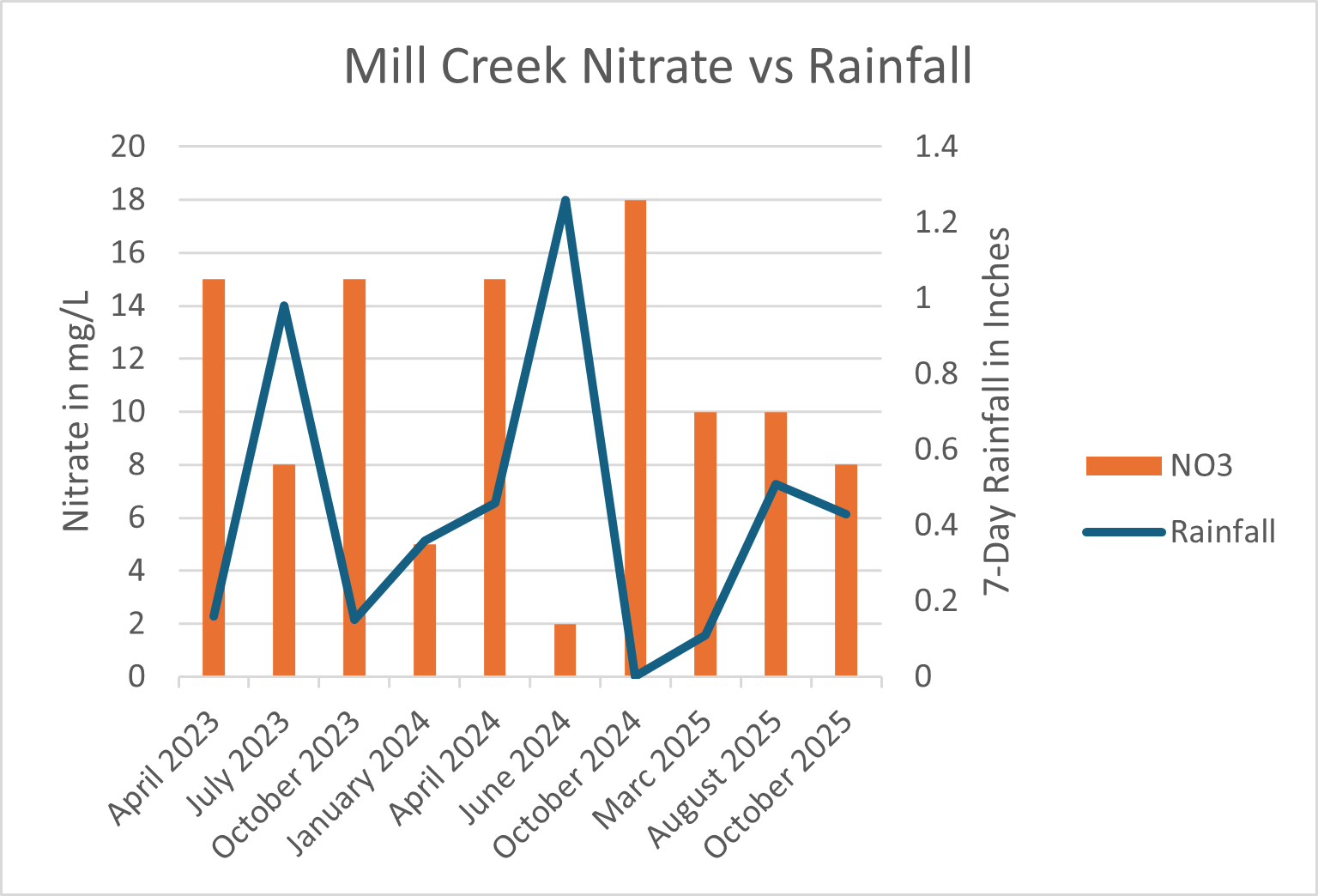
Macroinvertebrate Observations
Twice a year, macroinvertebrates are identified, counted, and categorized with respect to pollution tolerance. Macroinvertebrates act as reliable, long-term biological indicators of stream health, reacting to pollution and habitat changes with varying sensitivities. Many of them metamorphize into familiar insects such as Dragonflies, Damselflies, Mayflies, and (yech) mosquitoes. In aquatic food chains, these creatures break down tough organic matter and serve as a food source for amphibians, fish, reptiles, and other animals.
No clear relationship has been observed to-date between high nitrate concentrations and macroinvertebrate diversity at the Northgate location, but large numbers of Net Spinner Caddisflies that are tolerant of pollution and thrive in water containing high nutrient (nitrate) concentrations have been observed. The macroinvertebrate populations observed during the EMN MST sampling on Mill Creek have most frequently reflected fair water quality.
Mill Creek Watershed Monitoring
This newer study monitors eight locations along the length of Mill Creek from Olathe to the Kansas River. Key water quality parameters, including turbidity, total dissolved solids, pH, temperature, nitrate, and chloride, are monitored monthly. Our goal is to create an environmental profile of Mill Creek to better understand how land use and population density across the watershed affect stream water quality. This information is shared with the public to help citizens understand the human impacts on the County’s water resources and learn what can be done to reduce these impacts.
Why it is Important?
A healthy Mill Creek provides multiple benefits:
- The creek flows into the Kansas and Missouri Rivers, which provide drinking water for Kansas City and other downstream areas.
- Diverse populations of macroinvertebrates, amphibians, and fish contribute to abundance and biodiversity throughout the food chain.
- Seventeen miles of Mill Creek are adjacent to a JCPRD Streamway Park. This creek provides recreational opportunities, including fishing and children’s play and educational programs.
You can help keep our water clean! Visit the Water Quality homepage to learn more.