Prothonotary Warblers
The Prothonotary Warbler Nesting Box Study is a collaborative study between Johnson County K-State Extension Master Naturalists, Burroughs Audubon Society, Missouri Master Naturalists, Citizen Scientists in Kansas and Missouri, and others dedicated to “Protect the Prothonotary” by providing and monitoring nest boxes in appropriate habitat in eastern Kansas and Missouri.
A grant was provided by Burroughs Audubon in 2024 to place barometric pressure geolocators and Federal and study bands on 4 male Prothonotary Warblers in Kansas and Federal bands on additional Prothonotary Warblers and nestlings in the area. The work expanded in 2025 with more nesting boxes and additional banding and tagging of Prothonotary Warblers in Kansas and Missouri. In 2026 the first batch of data was retrieved from the geolocators. Read the article below to learn more.
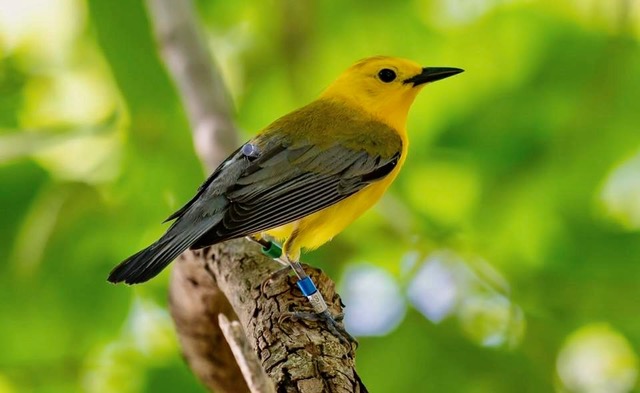 A Prothonotary warbler known as 'Hydrogen' with federal leg bands
Golden Gems of the Midwest: Tracking the Prothonotary Warbler
Glowing like a little ray of sunshine in wet woodlands, the Prothonotary Warbler (bander code: PROW) is hard to miss. With its brilliant golden-yellow plumage, blue-gray wings, and black beady eyes, this tiny songbird gets its unique name from the bright yellow robes worn by papal clerks (prothonotaries) in the Roman Catholic Church.
When they aren’t busy catching insects, caterpillars, and spiders, these birds travel long distances to winter in the mangrove and tropical forests of South America, with the country of Colombia hosting an astounding 90% of the population.
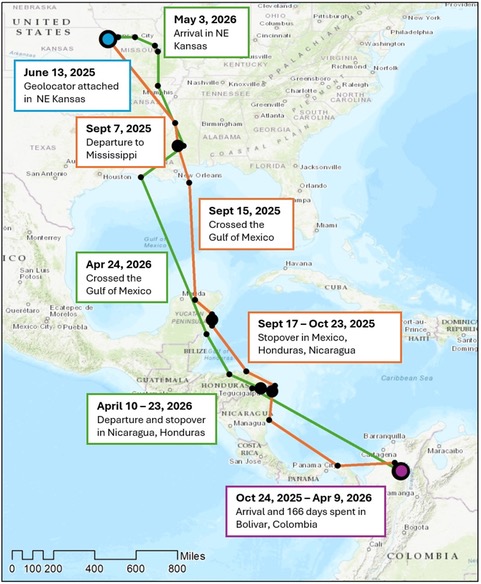 Migration map of Prothonotary warbler 'Hydrogen' 2025-2026
While PROW populations are facing steep declines in their traditional Gulf Coast breeding grounds, there is good news closer to home: their numbers in the Midwest, including Kansas and Missouri, are steady and even on the rise.
Unlike most warblers, the PROW is a cavity nester that naturally searches for old woodpecker holes in trees near water for nesting. Fortunately, recent research shows they readily move into man-made nest boxes too. To support and learn more about these gorgeous birds, the Johnson County Extension Master Naturalists have teamed up with Burroughs Audubon Society of Greater Kansas City, Sperry Galligar Audubon Society in SE Kansas, Pittsburg State University, and Louisiana State University.
Working under the Nestbox Stewards EMN Project, our local PROW team set up nest boxes in ideal spots around the Kansas City area, including JCPRD Parks, Wyandotte and Miami County Parks, and other natural areas in eastern Kansas and western Missouri. The best part? As our number of PROW nesting boxes grows, so does our local PROW population.
Providing housing is only half the fun. Our team also participates in migration studies led by Pittsburg State University and Louisiana State University to this Midwestern population. Local ornithologists place colorful study bands and a silver federal band on PROWs in our area. For the PROWs that qualify for the study, the ornithologists also place tiny barometric pressure geolocators on the backs of the birds. Once a tagged bird returns the following season, researchers can briefly recapture it to retrieve the geolocator data. This incredible technology reveals the exact path these warblers take between Kansas City and Colombia, giving us the insights we need to protect them every wingbeat of the way.
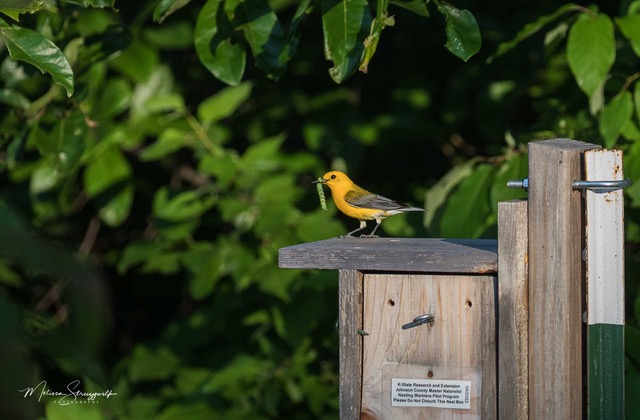 A Prothonotary known as 'Proton' with a caterpillar for his nestlings on his nesting box
More information on the work of the Prothonotary Warbler Team is available at these links:
- When They Come Home: The People Behind the Prothonotary Warbler’s Journey – Burroughs Audubon Society
- PROW Spotlight on Research – Burroughs Audubon Society
- Prothonotary Warblers in Kansas City Have a Secret. Can a Team of Volunteers Figure It Out? | Audubon
- Prothonotary Warbler Project – Burroughs Audubon Society
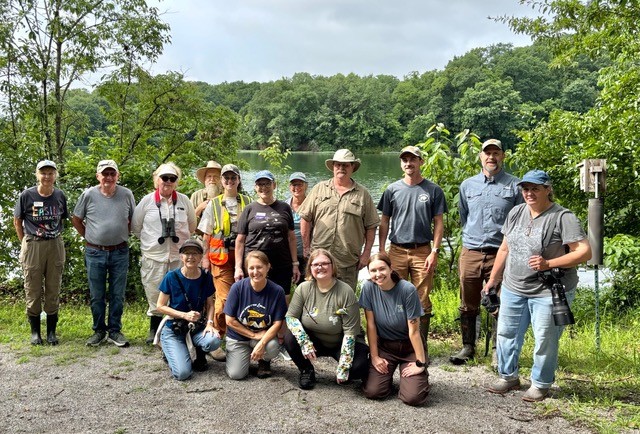 Some members of the Prothonotary Warbler Team June 2026