Helmets and Horns: The Really Cool World of Treehoppers
I love the Kansas State Flower—Helianthus annuus. Not only does it demand attention with its towering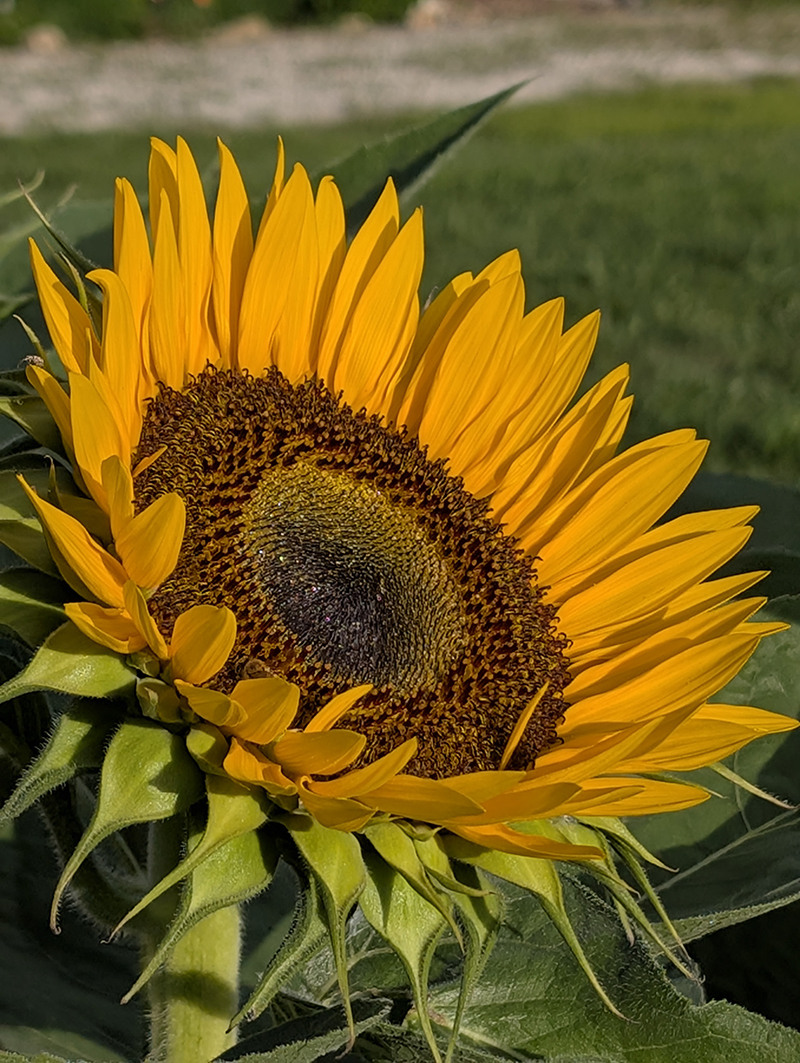 height, large leaves, and bold yellow flowers, but it is also a known host/nectar plant for more than 150 insect species. Sunflowers have tremendous potential to feed insects and animals in whichever niche they choose to occupy. Some only eat the disk florets (brown interior), some only eat through the stem of the flowers, and some live under the leaves and are only noticed when you go looking for them.
On a mammoth sunflower I was growing in my garden one year, I noticed a kink in the midvein of a leaf. It seemed like it was just mechanical damage from pushing up against a leaf while passing by. Imagine my surprise when, a few days later, more leaves began to exhibit this damage. I peered under a leaf to find something I had never seen before. A collection of these tan and brown things that had what looked like a hook or a serration on a saw on their back. Upon further research, I found out that they were keeled treehoppers (Entylia carinata).
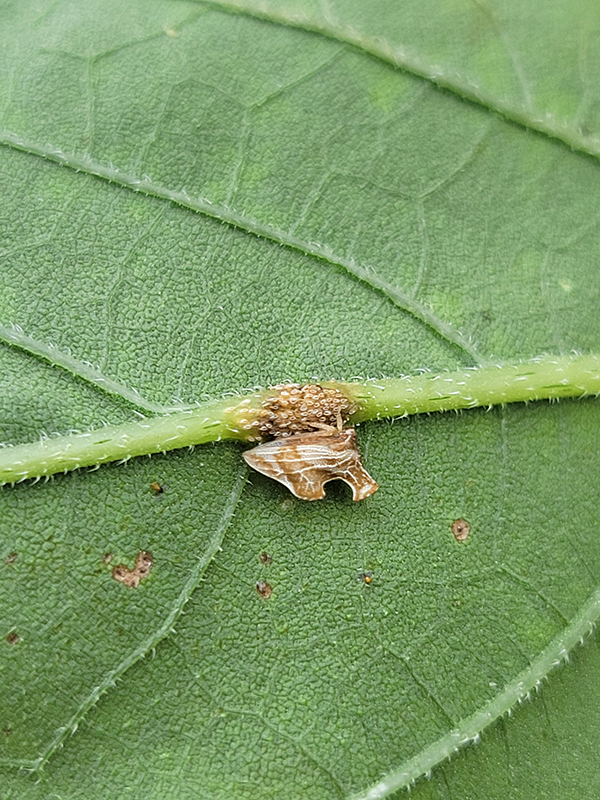 The keeled treehopper (Entylia carinata) is one of many species in the insect family Membracidae. This family belongs to the order Hemiptera, or true bugs, which also includes stink bugs, cicadas, and boxelder bugs. According to the Missouri Department of Conservation, there are more than 260 species of treehoppers in North America north of Mexico. A classic survey of Missouri treehoppers published in the Journal of the Kansas Entomological Society documented 85 species in the state. The defining feature of treehoppers is their enlarged pronotum—a hard, shield-like plate that covers the upper portion of the first segment of the thorax. In many species, the pronotum extends over the body to form elaborate shapes that resemble thorns, buds, or other plant structures, providing excellent camouflage.
Treehopper camouflage all depends on the plants that they have adapted to feed on. However, some of these are very noticeable to the naked eye. For example, oak leafhoppers (Platycotis vittata) have an interesting pronotum and a striking coloration that makes them stand out. Then there is the two-spotted leafhopper (Enchenopa binotata), which doesn’t have the most striking coloration (black with two yellow spots), but has a long pronotum resembling a unicorn horn. Big missed opportunity for a cool name, in my opinion.
As their name suggests, they can hop a pretty great distance in a single bound, maybe not over buildings, but definitely from tree to tree. They feed on plant sap using piercing-sucking mouthparts. Repeated piercing in one area, along with the female laying her eggs, is where the most noticeable damage occurs. On my sunflower from earlier, the bends in the leaf were caused by repeated piercing of the midvein.
Overall, these insects do not pose a wide-scale threat to plants. Their populations usually do not exceed a threshold that requires control. While they might feed on a plant and cause feeding damage, this damage is small and mostly cosmetic. There are always exceptions to the rule; the buffalo treehopper (Stictocephala bisonia) is a known pest of apples, and the three-cornered alfalfa hopper (Spissistilus festinus) can injure alfalfa, soybeans, and grapes. There is also the pseudo-curly top treehopper, known for vectoring disease to tomatoes and palm trees.
There are around 3,200 described species of treehoppers, with more being discovered in areas where scientific exploration has historically been minimal. If you are looking for an interesting afternoon, type treehoppers in an internet image search and see all of the colorful and odd-looking variations of it.
by Markis HIll, Horticulture Ornamentals and Turf, 2026