Making the Most of What’s Available
In Urban and Suburban environments, wildlife habitat can sometimes be sparse and isolated. City parks, wilderness areas, and nature preserves sometimes serve as a neighborhood’s only connection to nature and provide a limited amount of habitat for wildlife. Are there other spaces in our communities that could be used to expand the amount of available habitat for wildlife? A study by Megan Garfinkel in 2022 could provide the answer.
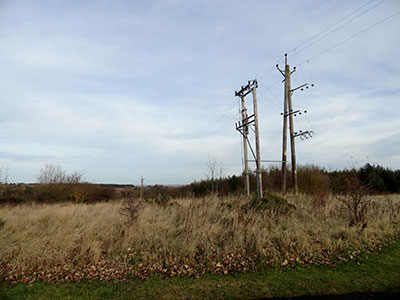 A common site in most neighborhoods and roadways are utility pole corridors. Garfinkel and her colleagues hypothesized that these corridors had the potential for something more if they were managed correctly. How much area are we talking about, though? Well, the US Department of Energy estimates that there are approximately 642,000 circuit miles of high-voltage transmission lines in the United States. In total, we’re talking about around 5 to 7.5 million acres of land. Traditionally these transmission line corridors are managed one of three ways: mowed regularly and managed like a lawn, brush-mowed every five years, or maintained as native prairie. The presence of transmission lines prohibits allowing vegetation to grow above a certain height, so forget about managing these areas for forest habitat. Could these corridors be used to expand available wildlife habitat in urban and suburban environments?
Garfinkel’s study examined diversity of insects, plants, and birds across each management type to see which type was most beneficial to wildlife. Garfinkel found that the prairie type and the 5-year brush mowed type had very similar biodiversity levels, while the lawn type had substantially lower biodiversity values. Overall, the study showed that the choice of management of utility pole corridors does impact wildlife diversity and could indeed provide a significant addition to usable wildlife habitat. Corridors should not be managed as lawns if the intended goal is to increase available wildlife habitat and overall diversity.
On a sidenote, it is strange and unexpected that the biodiversity levels that Garfinkel found at the prairie management sites were similar to the 5-year brush mowed sites. Shouldn’t a native prairie have much higher biodiversity than an area that is periodically mowed? This result could be due to the overall low quality of prairie Garfinkel observed at most sampling sites. Creating and maintaining high-quality prairie is difficult, time consuming, and possibly unfeasible for small, local workforces.
Sources:
Garfinkel, M., Hosler, S., Whelan, C., & Minor, E. (2022). Powerline corridors can add ecological value to suburban landscapes when not maintained as lawn. Sustainability, 14(12), 7113.
U.S. Department of Energy. Transforming U.S. Energy Infrastructures in a Time of Rapid Change: The First Installment of the Quadrennial Energy Review. U.S. Department of Energy: Washington, DC, USA, 2015.